

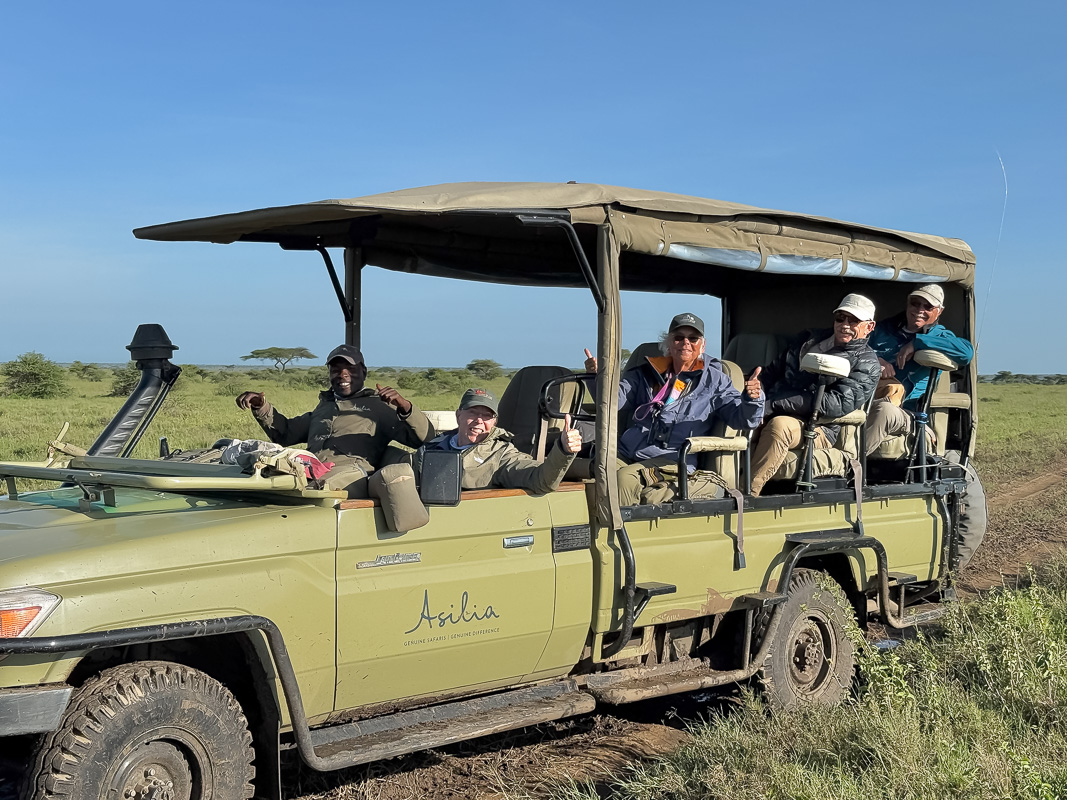
Safari is becoming more and more accessible to a wider range of travellers. While it is still a very costly activity, the proliferation of camps, the role of tourism in conservation, and the availability of affordable air travel have made it possible for more people to travel to wildlife areas than ever before. I believe this only positive; people care about things that they understand, and when the Natural world is under huge pressure, knowledge is everything.
But with the increase in visitor numbers comes a threat. At some point, tourism begins to impact on the very resource that it’s built upon. Some areas are starting to experience this, and many areas are already a long way down that road. Famous cases are the behaviour of guides in the Mara at river crossings, and of drivers in some of India’s national parks. Even areas like the South Luangwa National Park, which is much-hailed as an undiscovered wilderness, are rapidly losing that attribute in some parts.

As a result of increased numbers of tourists, camps in many areas are enjoying higher occupancies than previously. This has led to vehicles which used to cary just 2 or 3 guests being filled with as many as 6 or 9. In response to this, demand from regular visitors grew for a more exclusive experience where they didn’t have to share a vehicle with other guests, especially if their safari interests didn’t align. Not only did the camps therefore have to provide more vehicles at an additional cost, they saw this as an opportunity to turn private vehicles (and associated guide) into a revenue centre.
When camps were few, and areas undeveloped, additional vehicles allowed all guests to enjoy a safari that was tailored to their interests, and had little impact on the experience of others or on the wildlife. But as the popularity of private vehicles grew, and the number of camps proliferated, the benefits started to reverse in some areas. Camps with just 12 guests might be sending out 6 vehicles with just 2 people in each. When the neighbouring camp did the same, a private undeveloped safari area loses some of its appeal. Those 24 guests could be accommodated in 4 vehicles (or certainly 6 vehicles) rather than 12. Imagine the difference in the impact on a lion sighting of the presence of 4 vehicles….or 6 vehicles….or 12 vehicles.
Of course, I am simplifying things here. It’s important to remember that there is significant impact on a group of 4 guests to have an additional 2 people added to their vehicle. Or for a couple on their first safari to have a veteran couple added to the trip. It’s also hard for a guide to handle a mixed group which has very different levels of experience, so this situation should be considered from both the clients’ and the guides’ perspectives. There is certainly justification for private vehicles in some cases.
I am acutely aware of the private vehicle discussion because I automatically book a private vehicle for all my tours. It’s essential for me to have total autonomy over what I do with my group, and it’s a requirement from the camp because they can’t add non-photo-safari guests to my vehicle. I occasionally have small groups of 2 or 3 but I normally have 4 guests on my trips. I believe this is the best balance of cost (trips for 2 guests are very expensive), space in the vehicle (4 guests all have space to swing cameras and have a prime view) and impact on other guests and wildlife.
At this point, I wanted to outline what I believe are the advantages and disadvantages of a private vehicle, and what it entitles the occupants to do. A private vehicle:
- allows guests to set their own timings for safaris, within the constraints of the park/concession rules and the camp’s requirements;
- allows guests on the vehicle to determine what they do with their safari time and which sightings they want to prioritise;
- gives the guide the chance to make decisions on behalf of the group, knowing that their interests are all aligned;
- supports the wishes of special interest groups (birding, art or photography);
- avoids the risk of a personality mis-match where guests do not get along!
A private vehicle does not:
- give the group the ability to stay as long as they want on sightings if other vehicles wish to join;
- allow the vehicle to stay on a sighting when the animal is not comfortable with vehicle presence;
- offer privileged or priority access to sightings;
It is particularly this last point which I think is worth discussing more. If 6 guests split into 4 different vehicles (2 couples and 2 singles), they might have to share the ‘best’ location/viewing angle between them, and get just 25% of the time photographing from the optimal vantage point. Had they combined into 2 vehicles, they could have split the viewing time 50:50 which would have been beneficial for both groups.
Once again, I am aware that this is a simplification. But I am raising the question to lead me to 3 ‘take-aways’ from this discussion:
- Should allocated time on a sighting be split not per vehicle, but per guest? So a vehicle with 4 guests in it would be allowed twice as much time on a sighting as a vehicle with 2?
- I plan to continue to accommodate 4 guests on my trips because I feel that it is the best balance of cost and comfort. And I think it controls the number of vehicles which are operating in the camp’s area, to the benefit of wildlife and all guests’ experience.
- I would ask guests considering a private vehicle to ask whether they might trade time on sightings for that exclusivity?
The answer to this final question will depend on what they want to do with their safari time; if they want to enjoy extended time on predator sightings, they might be better in a vehicle with more guests since it reduces the number of vehicles attending these high-profile sightings. If they are birding, or looking for unusual species in the backcountry, this may not become an issue.
I don’t know the answer to this discussion, and I don’t mean to present one. This blog just intends to raise the questions and outline my thoughts about group size and why I keep mine at 4, rather than reducing to 3 or 2 as is sometimes requested.
A further topic for discussion is large groups of 9 or 12, split across 3 or 4 vehicles…and wanting to share the same sightings. But that’s for another day.
Leave A Comment